
Liar Liar!
Logic Problem #9

The Problem
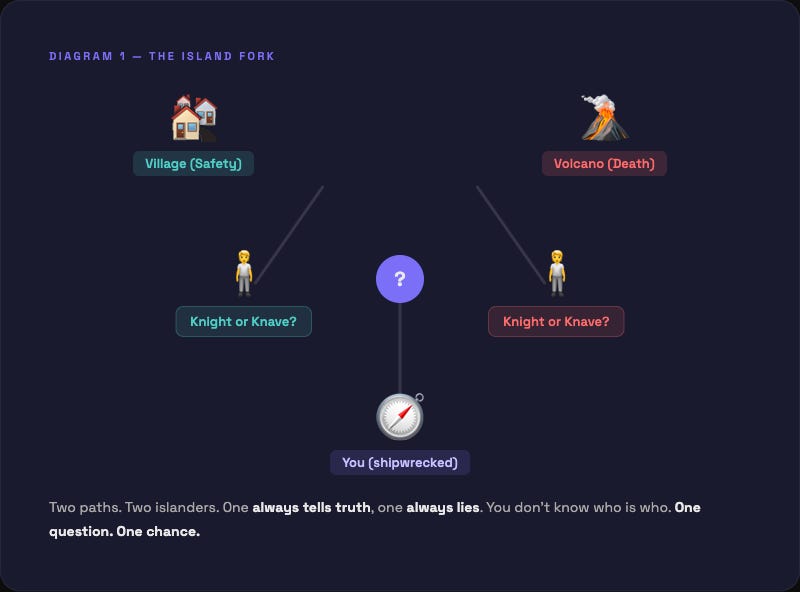
You’re shipwrecked. After days adrift, you wash ashore on a strange island. The good news: there’s a village with food, shelter, and a working radio. The bad news: there’s also an active volcano, and one wrong turn means you’re toast — literally.
You stumble inland until you reach a fork in the road. One path leads to the village (safety). The other leads straight into the volcano (certain death). You have no idea which is which.
Standing at the fork are two islanders. You know the following about this island’s inhabitants:
Knights always tell the truth. Every statement they make is perfectly honest.
Knaves always lie. Every statement they make is the exact opposite of the truth.
One of these two islanders is a Knight, and the other is a Knave. But you don’t know who is who. They look identical. No name tags. No helpful aura of honesty or deception.
You may ask one question to one person. That’s it. One shot.
What question do you ask to guarantee you find the path to the village?
Take a moment to think about it before scrolling down!
Solution
Why Simple Questions Fail
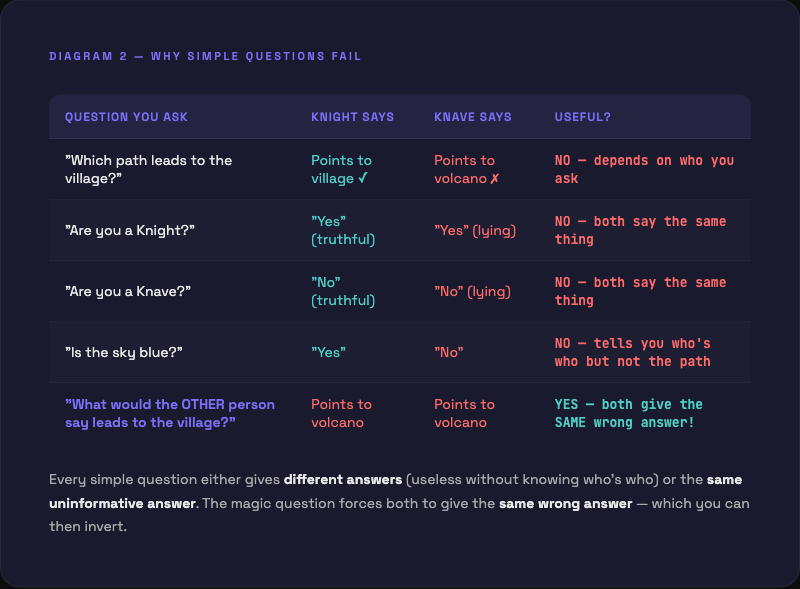
Your first instinct might be: just ask one of them, “Which path leads to the village?”
If you happen to ask the Knight, great — they’ll point to the village. But if you ask the Knave, they’ll point to the volcano. Since you don’t know who’s who, a direct question is a coin flip. Not good enough when lava is on the line.
What about asking “Are you a Knight?” Both would say yes — the Knight truthfully, the Knave falsely. Useless.
“Are you a Knave?” Both would say no. Also useless.
The problem is that any simple, single-layer question gives you different answers depending on who you ask, and you can’t tell them apart. You need something more devious.
The Key: A Question About the Other Person
Here’s the brilliant move. Walk up to either one of them and ask:
“If I asked the OTHER person which path leads to the village, what would they say?”
Then take the opposite path.
Let’s trace through why this works.
Case 1: You Ask the Knight
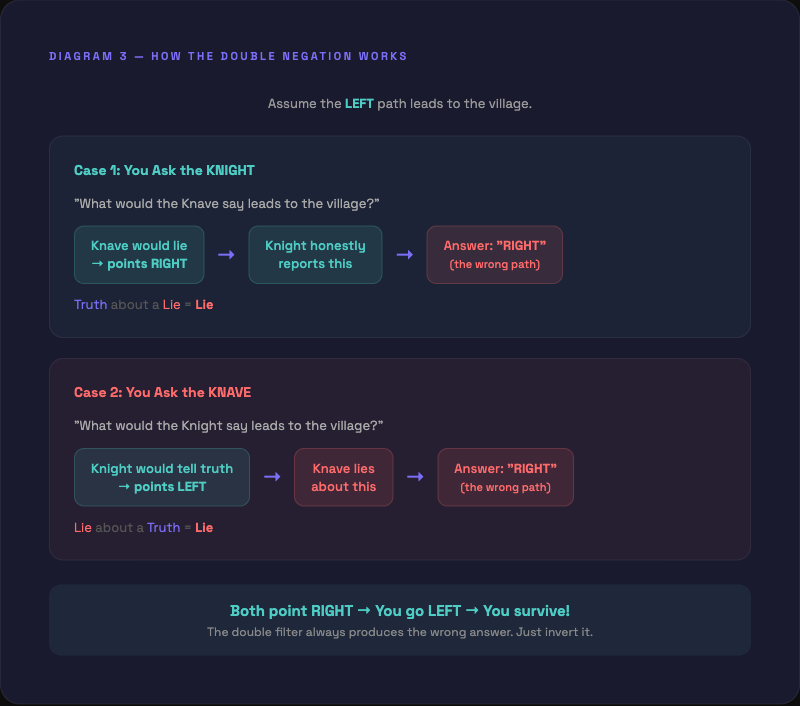
The Knight is honest. You’re asking them what the Knave would say.
The Knave always lies. So if the left path leads to the village, the Knave would point right (toward the volcano). The Knight, being truthful, accurately reports this: “They would say the right path.”
The Knight tells you the Knave’s answer, which is a lie. So you go the opposite way — left. You reach the village.
Case 2: You Ask the Knave
The Knave is a liar. You’re asking them what the Knight would say.
The Knight always tells the truth. So if the left path leads to the village, the Knight would point left. But the Knave lies about this and says: “They would say the right path.”
The Knave lies about the Knight’s answer, which flips a truth into a lie. So you go the opposite way — left. You reach the village.
The Beautiful Symmetry
Did you catch it? In both cases, the answer you get points to the volcano. Always. Regardless of who you ask.
Why? Because the question creates a double filter:
If you ask the Knight: truth about a lie = lie
If you ask the Knave: lie about a truth = lie
One layer of deception flips truth to falsehood. Two layers? Still falsehood. It’s like multiplying by negative one twice... except we’re nesting it, not multiplying. Truth(Lie(x)) = Lie(x) and Lie(Truth(x)) = Lie(x). Either way, you get the wrong answer — and since you know it’s wrong, you can just flip it.
That’s the magic of this puzzle. You don’t need to figure out who’s the Knight and who’s the Knave. You just need a question where it doesn’t matter.
An Alternative Formulation
Here’s another question that works just as well:
“If I asked YOU whether the left path leads to the village, would you say yes?”
This also creates a double negation when you ask the Knave (they lie about what their lie would be, producing truth) and a straight truth from the Knight. So both answer the same way! If they say yes, go left. If they say no, go right.
This version is arguably even more elegant because you only reference one person.

The Takeaway
The Knights and Knaves puzzle is a classic in logic and computer science. It shows up in job interviews, puzzle books, and even the movie Labyrinth (1986) with David Bowie.
But the deeper lesson is about self-correcting systems. When you can’t trust your information source, sometimes the solution isn’t to find a trustworthy one — it’s to design a question where the bias cancels itself out. Cryptographers, pollsters, and algorithm designers use versions of this trick every day.
Extension question: What if there were three islanders — a Knight, a Knave, and a Spy who answers completely randomly (sometimes truth, sometimes lies, no pattern)? You still need to find the safe path, but now you get two questions, each directed at one person. Can you guarantee survival?
(Hint: your first question should help you identify someone who is definitely not the Spy...)